
Equipment
Buying guide: fins
Full-foot or open-heel fins, soft or stiff blade, split or channelled: types, pros, cons, sizing and manufacturers.
For information only: it replaces neither training supervised by a qualified instructor nor medical advice.
In short
Fins turn the effort of your legs into movement. A good fin is first of all comfortable and suited to your strength. Too stiff, it tires you and causes cramps; too soft, it will not let you fight a current. The first choice is the foot pocket: bare foot (full-foot fin) or with a boot (open-heel fin).
Why it matters
Finning makes up most of the effort in diving. An unsuitable fin increases air consumption, breathlessness and the risk of cramp. A fin that hurts or comes off can also hinder an ascent or a surface swim back to the boat.
Diving fins
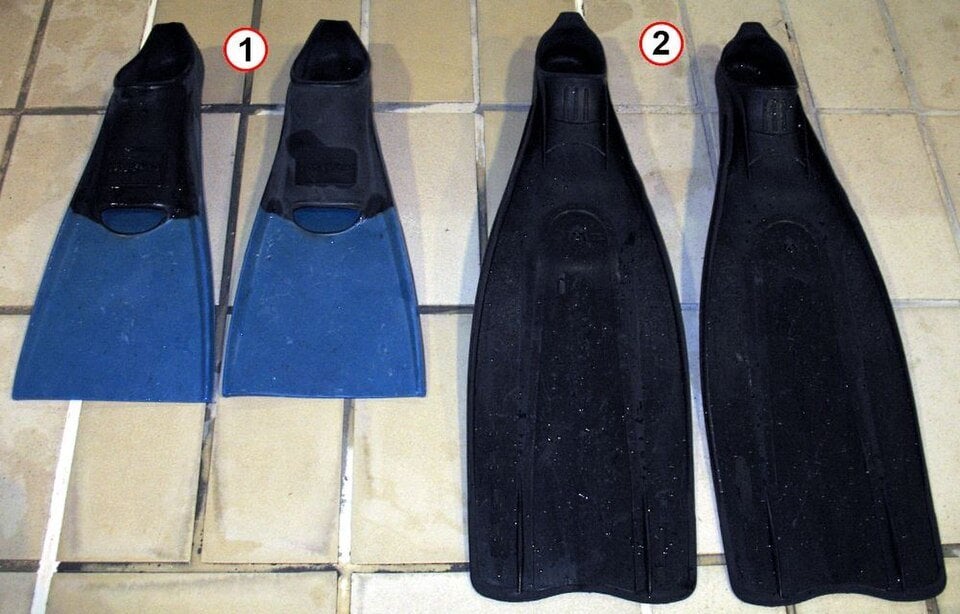
Full-foot or open-heel
| Type | Pros | Cons |
|---|---|---|
| Full-foot (closed heel) | Light, compact, good power transfer; ideal in warm water and from a boat | Bare foot: hard to walk on rocks; possible blisters; fixed size |
| Open-heel (adjustable) | Worn with a boot: foot protected and warm, you can walk to the water | Heavier and bulkier; you also need to buy boots |
For diving in mainland France and from the shore, open-heel fins with boots are the most common. When travelling to warm water, light full-foot fins make packing easier.
Straps
- Rubber strap with buckle: adjustable, fitted as standard on most models.
- Spring or bungee strap: easier to put on, especially with thick gloves; does not slip out of adjustment. It is a common accessory for open-heel fins.
Blades
| Blade | Pros | Cons |
|---|---|---|
| Solid, soft | Not tiring, suited to beginners and calm dives | Less effective in a current |
| Solid, stiff | Powerful, precise, allows technical kicks (frog kick, back kick) | Requires trained legs; cramps if it is too hard |
| Channelled or ribbed | Good balance between power and comfort | Effectiveness varies between models |
| Split | Very little effort, popular with divers who have fragile knees or ankles | Less power for sprinting; frog kick less effective |
| Heavy rubber (technical style) | Very durable, negative buoyancy that helps trim with a drysuit | Heavy to carry, requires good technique |
Choosing the stiffness
- Beginner or small build: soft to medium blade.
- Regular diver in currents: stiffer or channelled blade.
- Technical, wreck or cave diving: fins suited to the frog kick and back kick, often in rubber or a stiff composite material.
Size
- Full-foot: the size must be snug, without squeezing your toes; try it on wet.
- Open-heel: try it on with your boots; your heel must not touch the edge of the foot pocket and the fin must not twist around your foot.
- Fin length matters too: a long fin is more powerful but bulkier on a boat.
A few manufacturers
Non-exhaustive list, in alphabetical order, with no ranking and no sponsored link. Most generalist manufacturers offer full-foot and open-heel fins; check their current range on their website.
| Manufacturer | Official website |
|---|---|
| Aqualung | aqualung.com |
| Beuchat | beuchat.fr |
| Cressi | cressi.com |
| Mares | mares.com |
| Scubapro | scubapro.com |
| Seac | seacsub.com |
| Tusa | tusa.com |
Key takeaways
- Choose between full-foot (bare foot) and open-heel (with a boot) depending on where you dive.
- Stiffness must match your strength: too hard, it tires you and causes cramps.
- Try open-heel fins on with your boots.
- Spring straps make kitting up easier, especially with gloves.
- A suitable fin reduces effort and air consumption.
Further reading
The current guide explains how to manage your finning effort, and the wetsuit buying guide helps you choose boots. Rinse your fins in fresh water and store them flat, out of the sun.
Sources
- FFESSM – French Federation for Underwater Studies and Sports · consulted on 9 November 2026
- DAN Europe – Divers Alert Network Europe · consulted on 9 November 2026
Related guides
Buying guides: getting equipped to dive
Where to start, buying or renting, trying on, new or used, budget and maintenance: the method shared by all the diving equipment buying guides.
Buying guide: mask and snorkel
Single-lens, twin-lens, panoramic, full-face or prescription; plain, flexible or valve snorkel: types, pros, cons, fitting and manufacturers.
Buying guide: wetsuit, gloves and boots
Wetsuit, semi-dry or drysuit, thickness, size, boots, gloves and hood: types, pros, cons and manufacturers.
Diving in currents
Where currents come from, how to anticipate them, diving into the current or drifting, effects on air, and what to do if you are swept away.
Equipment care and storage
Rinsing, drying, periodic servicing, cylinder inspections and club equipment: keeping your gear reliable.