
Equipment
Buying guide: mask and snorkel
Single-lens, twin-lens, panoramic, full-face or prescription; plain, flexible or valve snorkel: types, pros, cons, fitting and manufacturers.
For information only: it replaces neither training supervised by a qualified instructor nor medical advice.
In short
The mask is the most personal piece of equipment. It must fit your face without pressing and let you pinch your nose to equalize your ears. Choose fit first, then volume and field of view. The snorkel is for the surface: a simple model with the right mouthpiece is enough for most divers.
Why it matters
A mask that leaks or fogs up distracts you and stops you reading your dive computer and following your buddy. A mask with too much volume needs more air to clear and equalize. If you cannot pinch your nose, you cannot equalize your ears, and you risk barotrauma.
Diving masks
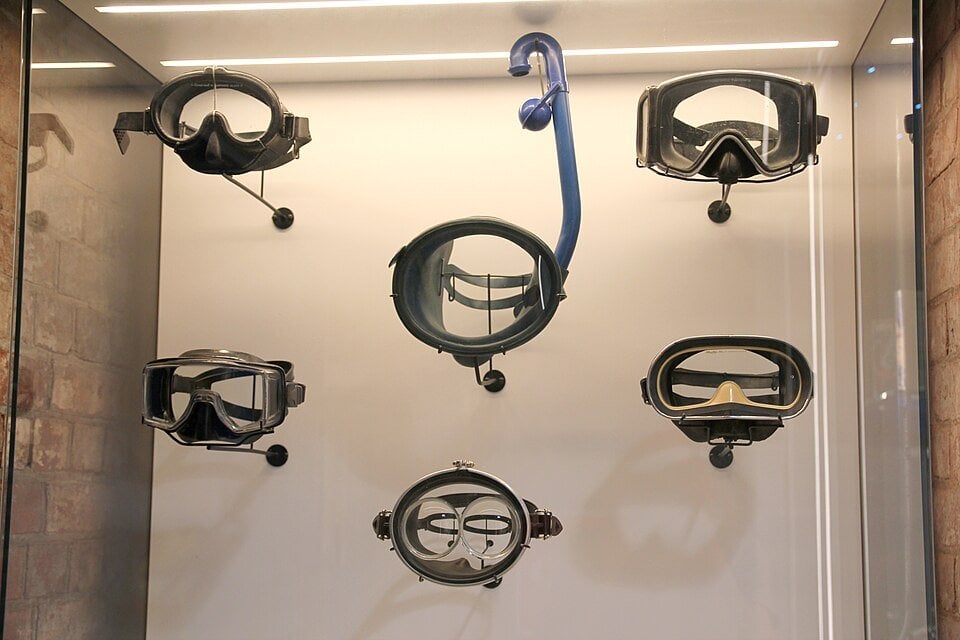
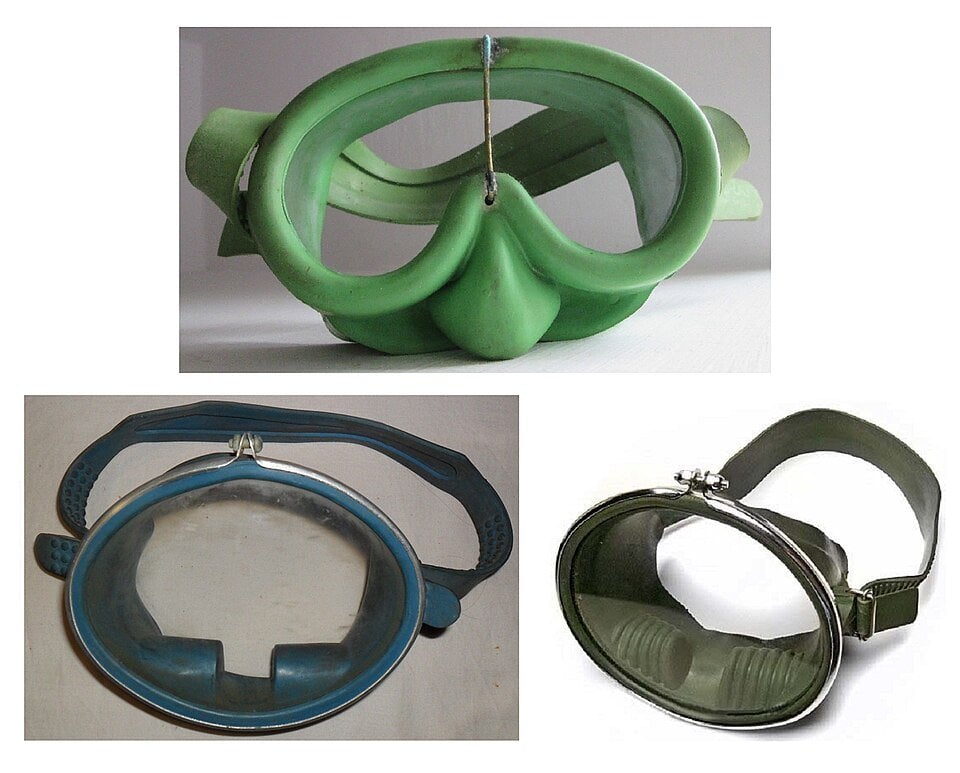
Types of masks
| Type | Pros | Cons |
|---|---|---|
| Single-lens | Continuous field of view, no frame in the middle | Often larger volume; no different prescription lenses for each eye |
| Twin-lens | Low volume, easy to clear; prescription lenses possible | Central frame in the field of view |
| Panoramic (side windows) | Wider peripheral vision | Larger volume, possible reflections, more fragile |
| Low-volume / frameless | Very compact, folds flat into a pocket (spare mask) | Skirt sometimes less forgiving depending on face shape |
| Full-face mask | Breathing through the nose, face protected from the cold, communication possible | Requires specific training; not suited to most recreational diving |
"Full-face" masks sold for snorkelling are not designed for scuba diving: never use them with a regulator.
Selection criteria
- Silicone skirt: soft and durable; clear for more light, black for fewer reflections (popular with photographers).
- Tempered glass lenses: insist on this marking; it is the standard on diving masks.
- Nose pocket you can reach with gloves, for equalization.
- Strap that is easy to adjust; a neoprene strap is more comfortable and does not pull your hair.
- Prescription lenses: most twin-lens masks accept suitable optical lenses, ordered from an optician or a dealer. Soft contact lenses are also used: talk to your ophthalmologist.
Trying on a mask
- Place the mask on your face without the strap, hair out of the way.
- Breathe in gently through your nose: a mask that fits stays on by itself, with no air leak.
- Check that it does not press on the bridge of your nose or your forehead, and that you can pinch your nose.
- Try again with your hood, or with a moustache if you have one: a moustache can make the skirt leak.
Preventing fogging
A new mask is covered with a manufacturing film that causes fogging. Clean it following the manufacturer's instructions before your first dive (non-abrasive toothpaste or a dedicated product), then use anti-fog on every dive. Never pass a flame over a mask with a silicone skirt or coated lenses: you could damage them.
Types of snorkels
| Type | Pros | Cons |
|---|---|---|
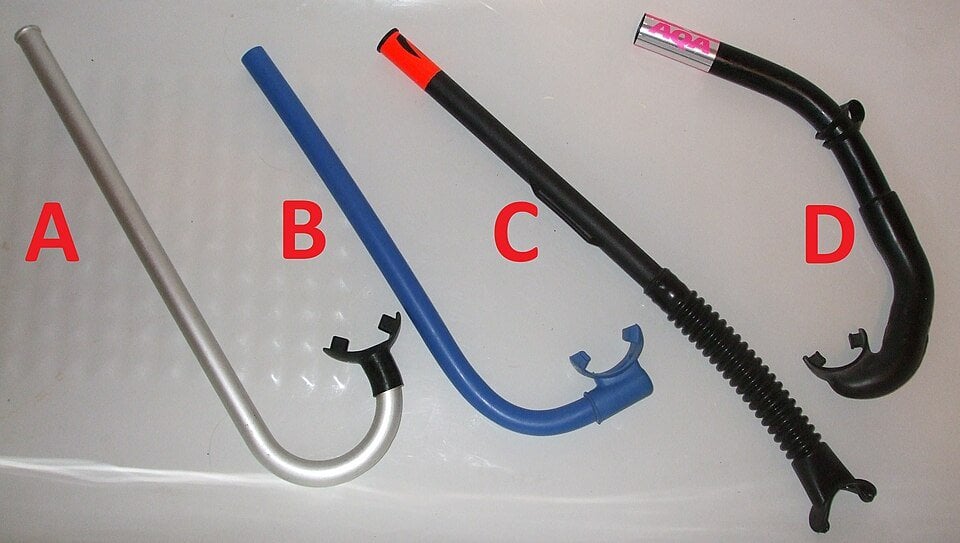
| Plain (J-shaped) | Light, reliable, nothing to go wrong | Can only be cleared by blowing |
| With purge valve | Low valve to clear water more easily | Valve needs maintenance, can jam with sand |
| Semi-dry / dry | Float or baffle at the top that limits water entry in choppy water | Bulkier, more drag underwater |
| Flexible / foldable | Fits in a pocket, does not get in the way of the regulator | Less comfortable for long surface swims |
Snorkels
Selection criteria
- Mouthpiece in soft silicone, sized for your jaw: a mouthpiece that is too big tires your mouth.
- Attachment to the mask strap that is easy to put on and take off.
- Diameter large enough to breathe without effort, without needlessly increasing dead space.
- Side: the snorkel goes on the left, as the regulator usually comes from the right.
A few manufacturers
Non-exhaustive list, in alphabetical order, with no ranking and no sponsored link. Most generalist manufacturers offer masks and snorkels; check their current range on their website.
| Manufacturer | Official website |
|---|---|
| Aqualung | aqualung.com |
| Beuchat | beuchat.fr |
| Cressi | cressi.com |
| Mares | mares.com |
| Scubapro | scubapro.com |
| Seac | seacsub.com |
| Tusa | tusa.com |
Key takeaways
- Choose fit first: the mask must stay on by itself when you breathe in through your nose.
- Twin-lens for low volume and prescription lenses, single-lens for a continuous field of view.
- Tempered glass lenses, a nose pocket you can reach with gloves.
- Clean a new mask before your first dive.
- A plain snorkel with a comfortable mouthpiece is enough in most cases.
Further reading
Carry a spare mask in a pocket on boat dives. The guides on barotrauma and on equipment maintenance complement this one.
Sources
- FFESSM – French Federation for Underwater Studies and Sports · consulted on 9 November 2026
- DAN Europe – Divers Alert Network Europe · consulted on 9 November 2026
Related guides
Buying guides: getting equipped to dive
Where to start, buying or renting, trying on, new or used, budget and maintenance: the method shared by all the diving equipment buying guides.
Buying guide: fins
Full-foot or open-heel fins, soft or stiff blade, split or channelled: types, pros, cons, sizing and manufacturers.
Scuba equipment
Cylinder, regulator, BCD and basic equipment: what each part does, how to assemble your scuba unit and check it.
Barotrauma
Ears, sinuses, mask, teeth, lungs: how pressure affects the body's air spaces and the simple actions that protect you.
Equipment care and storage
Rinsing, drying, periodic servicing, cylinder inspections and club equipment: keeping your gear reliable.