
Equipment
Buying guide: regulator
First stage, DIN or yoke, cold water, nitrox, octopus and pressure gauge: types, pros, cons, servicing and manufacturers.
For information only: it replaces neither training supervised by a qualified instructor nor medical advice.
In short
The regulator reduces the high pressure of the cylinder to a breathable pressure. It consists of a first stage fitted to the valve, a second stage in your mouth, a backup second stage (octopus), a pressure gauge and a hose for the BCD. For recreational diving, most recent regulators from well-known manufacturers breathe very well: the choice mainly depends on cold water, the connection type, the weight and how easy it is to get it serviced near you.
Why it matters
The regulator supplies the air for every breath. A model suited to the water you dive in, correctly configured and regularly serviced reduces the risk of freezing or free flow, and makes breathing more comfortable under exertion. It is also one of the most expensive items: it deserves to be chosen with care.
Regulators
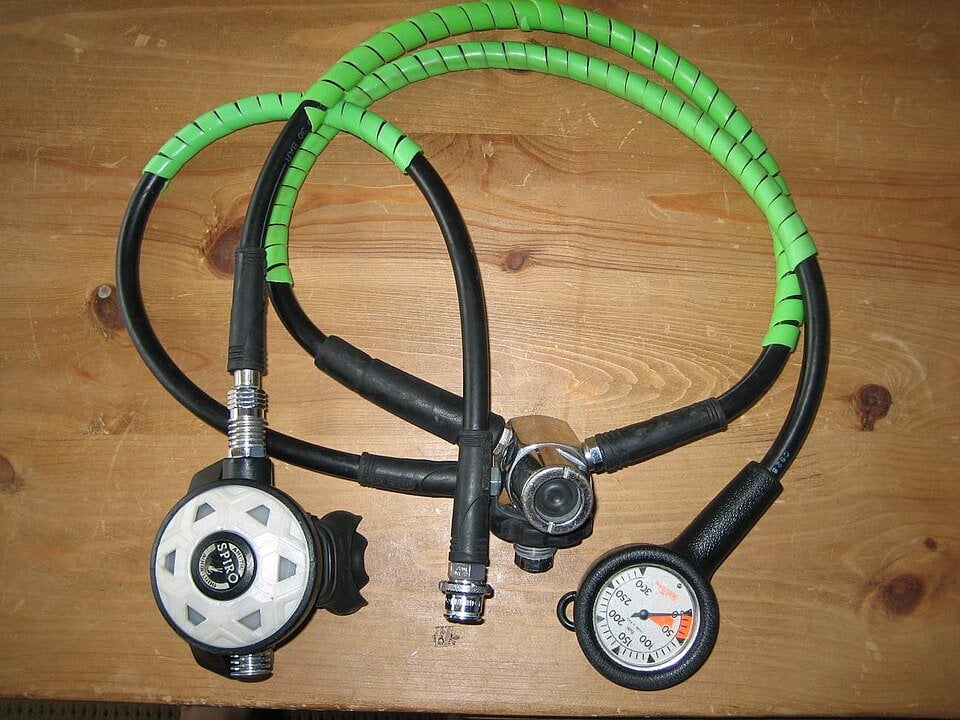
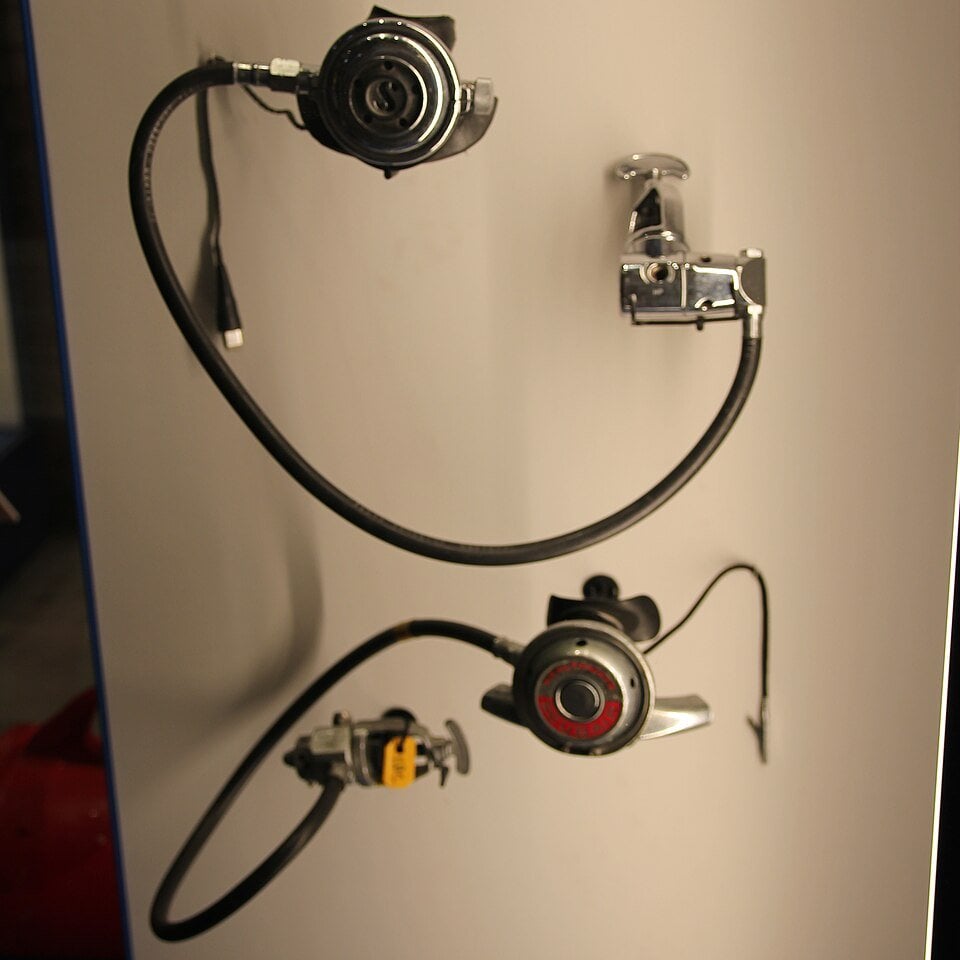
The first stage
| Type | Advantages | Disadvantages |
|---|---|---|
| Unbalanced piston | Simple, robust, affordable | Comfort drops as the cylinder pressure decreases |
| Balanced piston | High flow, consistent performance, simple servicing | Mechanism exposed to water, less suited to very cold water without protection |
| Balanced diaphragm | Consistent performance, mechanism isolated from water | A few more parts to service |
| Overbalanced / sealed diaphragm | Recommended in cold and silty water: sealed chamber, reduced risk of freezing | More expensive |
The cylinder connection
- Yoke (INT): fits all valves with an insert; common worldwide, especially when travelling.
- DIN: screwed into the valve, protected O-ring, suited to high pressures (300 bar); very common in Europe and standard in technical diving.
- An adapter lets you switch from one to the other; check the equipment used by the centres where you dive.
The ports
Several low-pressure ports (second stages, inflator hose, drysuit) and at least two high-pressure ports (pressure gauge, transmitter for a wireless dive computer). Swivelling ports make hose routing easier.
The second stage
- Breathing resistance adjustment and venturi control (pre-dive / dive): useful to limit free flow at the surface and adapt your breathing.
- Heat exchanger (metal parts): helps limit freezing in cold water.
- A comfortable, replaceable mouthpiece; a mouldable orthodontic mouthpiece reduces jaw fatigue.
- Weight: a light second stage tires your mouth less, especially when travelling.
Octopus, pressure gauge and hoses
- Octopus: backup second stage, brightly coloured, on a longer hose, stowed in the chest triangle. It must be as reliable as the primary one.
- Pressure gauge: mandatory, even with a transmitter-equipped dive computer, to check the pressure; a console with a compass is possible.
- Hoses: rubber (robust) or braided (light and flexible); lengths suited to your configuration.
In France, the regulations for diving in open water require, under certain depth and supervision conditions, a cylinder fitted with two independent outlets and two complete regulators. Check with your club or dive centre which equipment is required for your dives.
Cold water and nitrox
- Cold water: choose a regulator that its manufacturer states is suitable for cold water (tested to the European standard EN 250 in cold water), with a sealed first stage. In very cold water, two first stages on a twin-outlet valve are the rule.
- Nitrox: many regulators are nitrox-compatible out of the box up to 40% oxygen; above that, or for pure oxygen, specific preparation is required. Follow the manufacturer's instructions and your training. The app helps you prepare a nitrox dive (EAN21 to EAN40).
Servicing
- Rinse the regulator in fresh water after each day of diving, dust cap in place, without pressing the purge button.
- Have it serviced by a manufacturer-approved workshop at the stated interval (often every year or after a given number of dives), or sooner in case of free flow or hard breathing.
- Before buying, check that a workshop near you services the chosen brand and that parts kits are available.
Some manufacturers
Non-exhaustive list, in alphabetical order, with no ranking and no sponsored or affiliate links. Check the current range and the workshop network on each manufacturer's website.
| Manufacturer | Official website | Range |
|---|---|---|
| Apeks | apeksdiving.com | Recreational and technical |
| Aqualung | aqualung.com | Generalist |
| Atomic Aquatics | atomicaquatics.com | Specialist |
| Beuchat | beuchat.fr | Generalist |
| Cressi | cressi.com | Generalist |
| Hollis | hollis.com | Recreational and technical |
| Mares | mares.com | Generalist |
| Scubapro | scubapro.com | Generalist |
| Seac | seacsub.com | Generalist |
| Tusa | tusa.com | Generalist |
Key takeaways
- Choose first according to the water you dive in: in cold water, a suitable sealed first stage.
- DIN or yoke: match the cylinders you will use.
- The octopus and pressure gauge are part of a complete regulator.
- Check the nitrox compatibility stated by the manufacturer.
- Regular servicing in an approved workshop: find out before you buy.
Further reading
The scuba equipment guide describes how the regulator works, the air management guide explains how to monitor the pressure gauge, and the cylinder buying guide completes this choice.
Sources
- French Sports Code – Scuba diving (articles A322-71 onwards), Légifrance · consulted on 9 November 2026
- FFESSM – French Federation for Underwater Studies and Sports · consulted on 9 November 2026
- DAN Europe – Divers Alert Network Europe · consulted on 9 November 2026
Related guides
Buying guides: getting equipped to dive
Where to start, buying or renting, trying on, new or used, budget and maintenance: the method shared by all the diving equipment buying guides.
Scuba equipment
Cylinder, regulator, BCD and basic equipment: what each part does, how to assemble your scuba unit and check it.
Buying guide: diving cylinder
Steel or aluminium, volume, pressure, valves, nitrox, inspections and requalifications: types, pros, cons and manufacturers.
Buying guide: BCD
Jacket BCD, back-inflation, wing or sidemount, travel BCD: types, pros, cons, size, integrated weights and manufacturers.
Air management and out-of-air situations
Understanding your air consumption, planning your gas supply, watching your gauge, and reacting to an out-of-air situation or an equipment failure.
Equipment care and storage
Rinsing, drying, periodic servicing, cylinder inspections and club equipment: keeping your gear reliable.