
Equipment
Buying guide: diving cylinder
Steel or aluminium, volume, pressure, valves, nitrox, inspections and requalifications: types, pros, cons and manufacturers.
For information only: it replaces neither training supervised by a qualified instructor nor medical advice.
In short
The cylinder (or tank) holds the gas you breathe during the dive. Clubs and dive centres usually provide them: buying a cylinder becomes worthwhile if you often dive independently, if you get fills near home or if you need a particular configuration. The choices concern the material (steel or aluminium), the volume, the working pressure and the valve. A cylinder also requires regular regulatory inspections.
Why it matters
Volume and pressure determine how much gas is available, and therefore your gas supply and reserve. The material changes the buoyancy of the cylinder, and therefore your weighting. A cylinder is pressure equipment: a cylinder that is poorly maintained, corroded or overdue for inspection must not be filled.
Diving cylinders
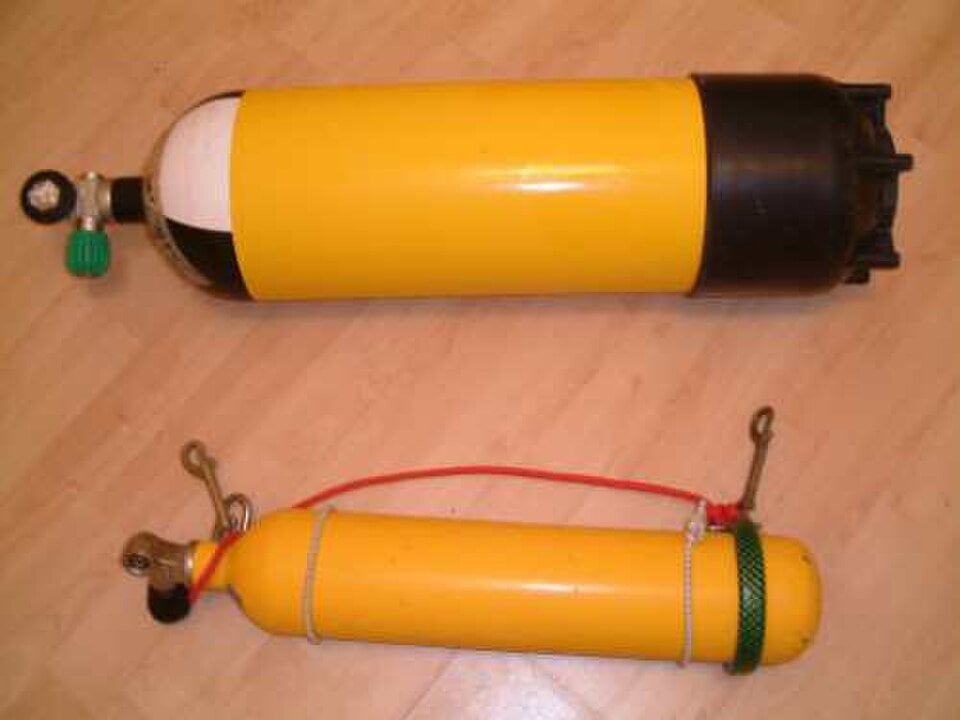
Steel or aluminium
| Material | Advantages | Disadvantages |
|---|---|---|
| Steel | Compact for a given volume, negative buoyancy (less weight), very common in Europe | Prone to corrosion if water gets in; heavier out of the water |
| Aluminium | Does not rust, common when travelling and in warm water | Bulkier, becomes buoyant at the end of the dive (more weight); thicker walls |
| Composite | Very light | Mainly professional or emergency use; limited lifespan and specific inspections |
Volume and working pressure
| Common cylinder | Typical use |
|---|---|
| 10 to 12 L, 200 to 232 bar | Recreational diving, the most common configuration in clubs |
| 15 L | Divers with high air consumption, long or deep dives |
| 2 × 7 L to 2 × 12 L (twin set) | Technical diving, redundant reserve |
| 3 to 7 L | Bailout cylinder, decompression stage, drysuit inflation (small cylinder) |
- A 300 bar cylinder requires a DIN valve and a compressor able to fill it; check the filling stations you use.
- A larger cylinder is not always more practical: it is heavier and changes your trim and your weighting.
- The air management guide explains how to calculate your gas supply and keep a reserve.
The valve
- Single outlet: a single first stage; light and simple.
- Twin outlet (valve with two independent outlets): lets you fit two complete regulators and shut down the one that is leaking. It is required in France under certain diving conditions and recommended in cold water.
- DIN or yoke: many valves accept both with a removable insert; choose according to your regulators.
- Twin set: two cylinders connected by a manifold with an isolation valve.
Nitrox and marking
- A cylinder intended for nitrox must be prepared and identified according to the regulations and the rules of the filling station (cleaning, marking, analysis label).
- Analyse the mix yourself before each dive and record it: the app then calculates the maximum operating depth (MOD) based on the chosen oxygen partial pressure.
Regulatory inspections
In France, a cylinder is subject to a periodic visual inspection (often carried out every year in clubs by a trained person, the "TIV") and to a periodic requalification whose interval depends on the applicable monitoring scheme. The dates are marked on the cylinder; a filling station refuses to fill a cylinder that is overdue. The exact rules are in the official texts listed in the sources; elsewhere, check the local regulations.
Do not buy a second-hand cylinder without knowing its date of manufacture and its latest inspections and requalifications. A cylinder that is corroded inside or has a damaged thread can be dangerous.
Good habits when buying
- Check that the valve is compatible with your regulators and that the diameter fits your BCD's cylinder strap.
- Plan for protection: a boot for a round-bottomed cylinder, a protective net, a valve cap.
- Keep the cylinder's invoice and certificate: they are requested during inspections.
- Include the cost of inspections, requalifications and fills in your budget.
Some manufacturers
Cylinders are made by specialised manufacturers, then often sold under the brand of diving equipment manufacturers. Non-exhaustive list, in alphabetical order, with no ranking and no sponsored or affiliate links.
| Manufacturer | Official website | Material |
|---|---|---|
| Faber | faber-italy.com | Steel |
| Luxfer | luxfercylinders.com | Aluminium and composite |
| Vítkovice Cylinders | vitkovicecylinders.cz | Steel |
Valves are offered by the regulator manufacturers listed in the regulator buying guide.
Key takeaways
- A personal cylinder is useful if you often dive independently or with a particular configuration.
- Steel: compact, less weight; aluminium: does not rust, more weight at the end of the dive.
- A twin-outlet valve for two independent regulators, required under certain conditions.
- A nitrox cylinder must be prepared and identified; analyse the mix before each dive.
- Inspections and requalifications up to date, otherwise no fill.
Further reading
The guides on scuba equipment, air management and equipment care complete this guide, as does the regulator buying guide. For nitrox, the dedicated guide and the app's preparation feature calculate the MOD.
Sources
- French order of 20 November 2017 on the in-service monitoring of pressure equipment, Légifrance · consulted on 9 November 2026
- French Sports Code – Scuba diving (articles A322-71 onwards), Légifrance · consulted on 9 November 2026
- FFESSM – Technical committee (visual inspection of cylinders, TIV) · consulted on 9 November 2026
Related guides
Buying guides: getting equipped to dive
Where to start, buying or renting, trying on, new or used, budget and maintenance: the method shared by all the diving equipment buying guides.
Scuba equipment
Cylinder, regulator, BCD and basic equipment: what each part does, how to assemble your scuba unit and check it.
Buying guide: regulator
First stage, DIN or yoke, cold water, nitrox, octopus and pressure gauge: types, pros, cons, servicing and manufacturers.
Air management and out-of-air situations
Understanding your air consumption, planning your gas supply, watching your gauge, and reacting to an out-of-air situation or an equipment failure.
Weighting and buoyancy
Archimedes' principle, finding the right weight, belt or integrated weights, buoyancy control with the BCD and the lungs, and the risks of poor weighting.
Equipment care and storage
Rinsing, drying, periodic servicing, cylinder inspections and club equipment: keeping your gear reliable.